
 English
 русский
Content
- 1 The Science of the Passive Layer: Why Stainless Steel Resists Rust
- 2 Key Alloying Elements and Their Role in Corrosion Resistance
- 3 How Manufacturing Processes Impact Corrosion Performance
- 4 Common Types of Corrosion in Stainless Steel Pipes
- 5 A Practical Guide: Selecting the Right Grade for Your Environment
- 6 Industry Certifications: What NORSOK M650 and ABS Mean for Corrosion Resistance
- 7 Maintenance and Best Practices to Preserve Corrosion Resistance
A chemical plant operator inspects a 316L pipeline after six months of dilute hydrochloric acid service. The base metal gleams like new, but the heat-affected zones alongside welds show distinct pitting. That one observation sums up the paradox of stainless steel corrosion resistance: the material is remarkably resilient, yet its performance depends on far more than just picking a grade number off a chart.
Rust never sleeps, but on stainless steel it often loses. The secret is a self-repairing oxide skin only a few nanometers thick. This article moves past that familiar story to examine how alloying decisions, manufacturing processes, and maintenance routines turn generic “stainless” into genuinely fit-for-purpose pipe systems for industries as demanding as offshore gas production, pharmaceutical processing, and marine engineering.
The Science of the Passive Layer: Why Stainless Steel Resists Rust
Stainless steel becomes “stainless” only when its chromium content reaches a minimum of 10.5 % by mass. At that threshold, chromium atoms react spontaneously with oxygen from air or water, forming a continuous, transparent film of chromium oxide (Cr₂O₃). This passive layer is both electronically insulating and chemically stable — it blocks the anodic dissolution that turns ordinary carbon steel into rust in hours.
The film is not static. When scratched or locally attacked, fresh chromium immediately binds with available oxygen to heal the breach. That self-repair cycle is the single most important property of stainless steel. However, the film’s stability collapses if the environment is reducing (low oxygen), if aggressive anions like chloride ions concentrate at the surface, or if the temperature exceeds the critical pitting threshold for that specific grade. In 304 stainless steel exposed to neutral 3.5 % NaCl solution at 25 °C, pitting can initiate within hours once the local potential exceeds the pitting potential, typically around +0.2 V to +0.3 V versus SCE. By contrast, 316L’s molybdenum addition pushes the pitting potential to around +0.5 V, dramatically delaying attack.
For this reason, the passive layer is frequently described as the material’s electrochemical armor. But how thick and uniform that armor becomes is heavily shaped by the pipe’s manufacturing history — a factor the industry is only recently quantifying.
Key Alloying Elements and Their Role in Corrosion Resistance
Chromium alone makes stainless steel possible. Nickel, molybdenum, and nitrogen make it predictable. Each element brings a specific electrochemical contribution that engineers can exploit — or ignore at their peril.
The PREN (Pitting Resistance Equivalent Number) formula — PREN = %Cr + 3.3(%Mo) + 16(%N) — is the quickest way to compare pitting resistance across grades. A PREN below 18 indicates vulnerability in seawater; a PREN above 40 signals readiness for hot, concentrated chlorides. The table below puts common tube grades into context.
| Grade | Typical Cr (%) | Typical Mo (%) | Typical N (%) | PREN |
|---|---|---|---|---|
| 304 / 304L | 18.0 – 20.0 | — | — | 18 – 20 |
| 316 / 316L | 16.5 – 18.5 | 2.0 – 2.5 | — | 23 – 26 |
| 317L | 18.0 – 20.0 | 3.0 – 4.0 | — | 28 – 32 |
| 2205 Duplex | 22.0 – 23.0 | 3.0 – 3.5 | 0.14 – 0.20 | 33 – 38 |
| 2507 Super Duplex | 24.0 – 26.0 | 3.0 – 5.0 | 0.24 – 0.32 | 40 – 45 |
| 904L | 19.0 – 23.0 | 4.0 – 5.0 | — | 32 – 38 |
Nickel does not directly improve pitting resistance, but it stabilizes the austenitic structure and enhances resistance to stress corrosion cracking in chloride media when present above about 8–10 %. For environments containing sulfuric or phosphoric acid, copper additions (as in 904L) can be equally decisive. Meanwhile, carbon is the enemy: even 0.08 % carbon can combine with chromium at grain boundaries during welding, creating chromium-depleted zones susceptible to intergranular attack. That’s why low-carbon “L” grades (max 0.03 % C) are mandatory for welded pipe assemblies that cannot be post-weld heat-treated.
How Manufacturing Processes Impact Corrosion Performance
Two identical 316L pipes can exhibit dramatically different corrosion resistance depending on how they were made. The reason is surface quality — or more precisely, the continuity and composition of the passive layer that the surface supports.
Hot-finished or pickled pipe typically has a surface roughness (Ra) of 3–6 μm and may retain a mill scale or shallow chromium-depleted layer. When that surface meets a corrosive medium, the passive film forms unevenly, and microscopic crevices become initiation sites for pitting. Cold-rolled or cold-drawn tube achieves a smoother surface, but the real leap forward comes with bright annealing (BA) and electropolishing (EP).
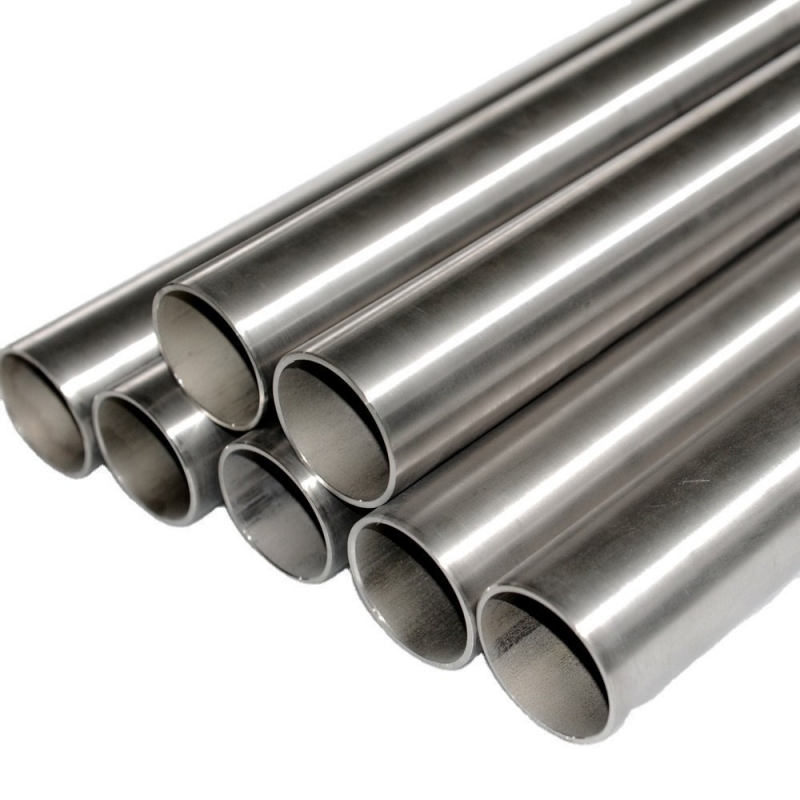
Bright annealing is performed in a controlled hydrogen or vacuum atmosphere, which prevents oxide scaling and leaves the surface with a uniform, mirror-like finish and Ra below 0.6 μm. Because no oxygen-rich scale forms, the as-annealed surface retains its full chromium content, enabling a more stable passive layer from the start. EP goes further: it dissolved a few microns of surface metal in an acid bath under controlled current, eliminating embedded contaminants and microcracks. The resulting Ra can reach ≤ 0.2 μm, and Auger electron spectroscopy confirms that the Cr-to-Fe ratio at the EP surface can be as much as 1.5 times that of the bulk material.
The practical difference is measurable. In ASTM G48 Method A tests (6 % FeCl₃, 72 h at 22 °C), standard pickled 316L tube can show a weight loss exceeding 10 g/m², while BA and EP tubes of the same heat routinely record less than 2 g/m². For chloride-heavy applications, specifying a stainless steel BA tube or stainless steel EP tube is not a cosmetic preference; it is a direct corrosion-control measure.
Common Types of Corrosion in Stainless Steel Pipes
Stainless steel corrosion rarely looks like the uniform rusting of carbon steel. Instead, it is localized, deceptive, and often tied to operational mistakes. Recognizing the specific mechanism is half the solution.
- Pitting corrosion: Concentrated chloride ions breach the passive film at microscopic weak points — often manganese sulfide inclusions. Once initiated, the pit grows autocatalytically. The critical pitting temperature (CPT) for 304L in 3.5 % NaCl is around 15 °C; for 316L it rises to about 25 °C.
- Crevice corrosion: Under gaskets, deposits, or overlapping surfaces, oxygen becomes depleted, locally destroying passivity and creating an acidic micro-environment. 304L is especially vulnerable; 316L and duplex grades offer higher resistance.
- Intergranular corrosion: Occurs when chromium carbides precipitate at grain boundaries during slow cooling or welding. Testing per ASTM A262 Practice E (Streicher test) is used to detect this sensitization. Low-carbon and stabilized grades (321, 347) prevent it.
- Stress corrosion cracking (SCC): Most common in chloride environments above 60 °C when tensile stress is present. Austenitic grades like 304 and 316 are susceptible unless nickel content is raised above 30 % or duplex microstructure is used.
Each of these failure modes leaves a characteristic fingerprint. A metallographic examination complemented by energy-dispersive X-ray spectroscopy (EDS) can usually pinpoint whether chromium depletion, inclusion density, or environmental fluid was the primary driver.
A Practical Guide: Selecting the Right Grade for Your Environment
Grade selection should never start with a generic “upgrade to 316.” Instead, it begins with three questions: what is the chloride concentration, what is the maximum operating temperature, and what is the pH range. The matrix below offers a starting point for pipe systems.
| Environment | Chloride Level | Temperature Range | Recommended Grades |
|---|---|---|---|
| Potable water, urban atmospheres | < 200 ppm | 0 – 40 °C | 304L, 316L |
| Swimming pool halls, coastal air | 200 – 500 ppm (occasional condensation) | 10 – 70 °C | 316L, 2205 (for structural) |
| Brackish cooling water | 500 – 5 000 ppm | 20 – 50 °C | 2205, 2507 |
| Seawater (full strength) | ≈ 19 000 ppm | 0 – 40 °C | 2507, 6% Mo superaustenitic |
| Chemical process: dilute H₂SO₄ | Trace | 40 – 80 °C | 316L (up to 5%), 904L or 2205 for higher concentrations |
| High-purity gas, semiconductor | None (cleanrooms) | Ambient | Precision stainless steel tube with EP finish |
Temperature exerts an exponential effect: a rise of 10 °C can double the pitting rate in chloride media. Wherever the process stream might alternate between wet and dry conditions, crevice corrosion risk multiplies. In such cases, chemical-grade stainless steel pipe with fully fused, smooth welds and low-inclusion raw material becomes essential.
Industry Certifications: What NORSOK M650 and ABS Mean for Corrosion Resistance
Grade selection alone cannot guarantee performance in high-risk environments. That’s where technical delivery conditions like NORSOK M650 step in. This Norwegian standard, widely adopted for offshore oil and gas, requires that stainless steel pipe and fittings pass a battery of qualification tests that go far beyond routine mill checks.
A NORSOK M650-qualified 22Cr duplex pipe, for starters, must demonstrate resistance to sulfide stress cracking (SSC) in environments with up to 1 bar H₂S at pH 4.5, as per ISO 15156 / NACE MR0175. The standard also demands strict microstructural control — no intermetallic phases, no continuous grain boundary precipitates — because even a few percent of sigma phase can slash the CPT by 20 °C. ABS (American Bureau of Shipping) approval for marine piping adds cyclic corrosion testing and impact toughness requirements that indirectly assure a clean, corrosion-resistant surface capable of withstanding the aggressive splash zone.
When a specification calls for “316L to NORSOK M650,” it is effectively saying: the pipe’s corrosion resistance has been validated not only in the laboratory but under conditions that simulate the hydrogen-charged, chloride-saturated reality of a subsea manifold. That certification trail is the closest thing to an insurance policy for long-term asset integrity.
Maintenance and Best Practices to Preserve Corrosion Resistance
Even the most perfectly manufactured stainless steel pipe will eventually corrode if the passive layer is not given a chance to regenerate. Regular maintenance revolves around three actions: cleaning, passivation, and inspection.
- Remove deposits: Use chloride-free alkaline or neutral detergents. Avoid steel wool or carbon steel brushes, which embed iron particles that rust and disrupt the passive film.
- Passivate promptly: After any mechanical work, re-passivate the surface using a nitric acid or citric acid solution tailored to the grade. This dissolves free iron and encourages the formation of a uniform oxide layer.
- Monitor for early signs: Periodic borescope inspection of weld roots and gasket seating areas can catch crevice or pitting corrosion before a leak develops. For critical lines, electrochemical noise monitoring or corrosion coupons provide early warning.
A simple practice — rinsing stainless surfaces exposed to road salt or marine spray with fresh water every few weeks — can extend service life by decades. The passive layer is forgiving, but only if the environment permits the oxygen that fuels its self-repair.
At every scale, from the atomic oxide film to kilometers of industrial pipework, stainless steel corrosion resistance is an engineered property, not a given. The choice of chromium and molybdenum levels decides the material’s resistance ceiling; the manufacturing route — hot finishing, bright annealing, electropolishing — determines how close to that ceiling the installed pipe can operate; and maintenance keeps the protective film alive. For engineers specifying pipe for aggressive media, the combination of a matched grade, a verified surface finish, and a recognized certification like NORSOK M650 provides the most reliable defense against premature failure.