
 English
 русский
Content
- 1 The Science Behind Stainless Steel Corrosion Resistance
- 2 Key Factors That Compromise the Passive Layer
- 3 Grade Selection: 304 vs 316L vs Duplex Stainless Steel
- 4 How Manufacturing Processes Influence Corrosion Resistance
- 5 The Weak Link: Welded Joints and Fittings
- 6 Industry Standards and Certifications: What They Mean for Your Project
- 7 Practical Selection Guide: A Step-by-Step Decision Framework
The Science Behind Stainless Steel Corrosion Resistance
Stainless steel owes its corrosion resistance to a thin, self-healing oxide film. Chromium—present in amounts of at least 10.5% by mass—reacts with oxygen in air or water to form a stable chromium oxide (Cr₂O₃) layer just a few nanometers thick. This passive film acts as a barrier, preventing aggressive ions from reaching the underlying metal.
What sets stainless steel apart from a simple coating is the film’s ability to repair itself. If the surface is scratched or damaged, chromium from the alloy migrates to the exposed area and instantly re-forms the oxide in the presence of oxygen. The effectiveness of this self-healing mechanism depends directly on the chromium content, the alloy’s molybdenum and nitrogen additions, and the cleanliness of the surface.
To quantify resistance to localized attack such as pitting, engineers use the Pitting Resistance Equivalent Number (PREN). The formula PREN = %Cr + 3.3 × %Mo + 16 × %N provides a reliable relative ranking. A few typical values illustrate the point:
| Grade | Approximate PREN | Typical Environment |
|---|---|---|
| 304 (UNS S30400) | 18–20 | Mild atmospheric, fresh water |
| 316L (UNS S31603) | 24–26 | Coastal, light chloride |
| Duplex 2205 (UNS S31803) | 34–36 | Seawater, chemical processing |
| Super Duplex 2507 | 40–44 | Offshore, hot chlorides |
These numbers explain why a standard 304 tube may fail rapidly in a marine atmosphere while a duplex grade lasts for decades. Understanding PREN is the first step toward rational material selection.
Key Factors That Compromise the Passive Layer
Even the best stainless steel can corrode if the protective film breaks down. Three environmental variables dominate: chloride ion concentration, temperature, and pH. Chlorides penetrate the passive film at local weak points, initiating pitting. Concentrations as low as a few parts per million can cause damage when the metal surface is not optimized.
Temperature accelerates every electrochemical reaction. Above 60 °C, the pitting risk for standard austenitic grades jumps sharply. In acidic conditions—below pH 4—the oxide layer dissolves, while highly alkaline solutions above pH 10 can induce stress corrosion cracking in susceptible alloys. Mechanical abrasion or poor handling also removes the film, and if the surrounding medium lacks sufficient oxygen for repassivation, corrosion propagates.
The table below compares the critical pitting temperature (CPT) of two popular grades in a 3.5% NaCl solution, a standard seawater proxy.
| Grade | CPT (°C) | Behaviour in stagnant chlorides |
|---|---|---|
| 304 | < 25 | Prone to crevice corrosion |
| 316L | 25–45 | Better resistance, still vulnerable to deposits |
Real-world consequences follow the science. A 304 pipe carrying warm, slightly chlorinated water may pit within months. For those conditions, a 316L or a duplex grade is the practical minimum.
Grade Selection: 304 vs 316L vs Duplex Stainless Steel
Selecting the right grade means matching alloy composition to corrosion risk. Grade 304, with 18-20% Cr and no intentional molybdenum, handles fresh water, mild chemicals, and indoor atmospheres. Grade 316L adds 2-3% molybdenum, significantly raising PREN and resistance to chlorides. For any application involving frequent wet-dry cycles, road de-icing salts, or coastal fog, 316L is the safe baseline. Duplex stainless steels such as 2205 combine an austenitic-ferritic microstructure with higher chromium, molybdenum, and nitrogen, yielding PREN values above 34. They also deliver roughly twice the yield strength of 316L, enabling lighter, cost-effective designs in aggressive environments.
The decision matrix below consolidates the key parameters.
| Grade | PREN | Mo (%) | Typical Use | Relative Cost |
|---|---|---|---|---|
| 304 | 18–20 | 0 | Potable water, architectural, low-corrosion industrial | Low |
| 316L | 24–26 | 2–3 | Chemical transfer, food & beverage, pharmaceutical piping | Medium |
| Duplex 2205 | 34–36 | 3–3.5 | Seawater cooling, heat exchangers, oil & gas | High |
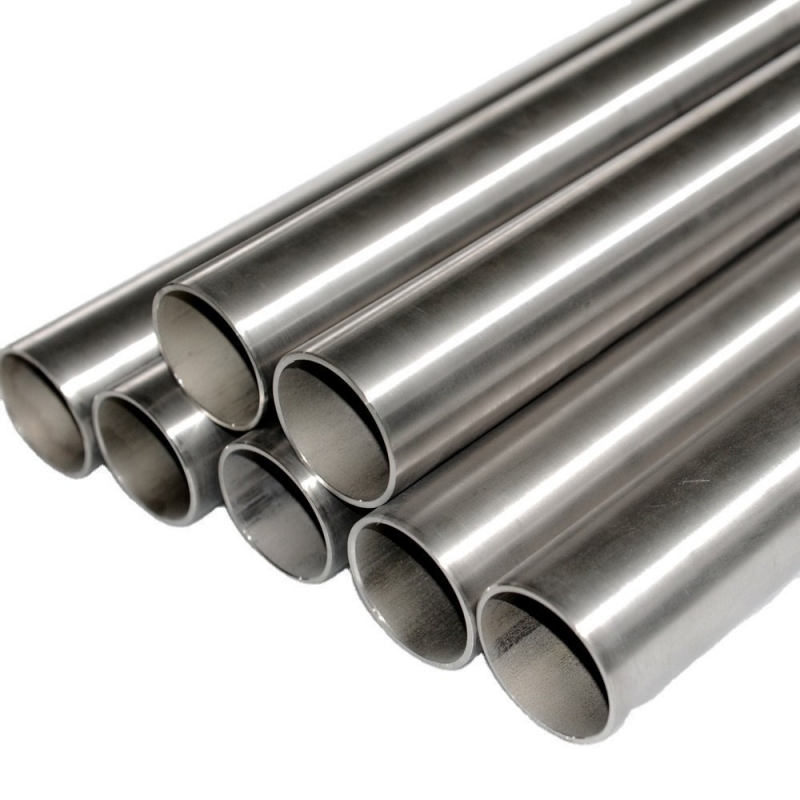
For food-contact and sanitary piping, where cleanability and resistance to cleaning chemicals matter, a sanitary stainless steel seamless tube in 316L is a standard choice. In heavy industrial fluid transport, making the right grade-and-process choice upfront prevents unscheduled shutdowns.
How Manufacturing Processes Influence Corrosion Resistance
Alloy chemistry sets the potential, but surface condition dictates the reality. Surface roughness—expressed as Ra in micrometers—controls how easily chlorides can nucleate pits. A polished, defect-free surface delays attack and makes stable passive film formation easier. Three common finishing routes give distinctly different outcomes.
Electropolishing (EP) removes a thin layer of metal, leveling micro-peaks and eliminating embedded contaminants. The resulting Ra is typically below 0.4 µm. Independent laboratory studies show that EP-finished tubes can lower corrosion rate by 30–50% compared with mechanically polished surfaces in identical chloride environments. Bright annealing (BA) is performed in a controlled protective atmosphere, preventing oxidation while preserving a smooth reflective finish with Ra around 0.4–0.8 µm. Mechanical polishing (MP) yields Ra between 1.6 and 3.2 µm, often leaving abrasive residues that create crevice sites.
| Finish | Ra (µm) typical | Pitting resistance gain | Recommended environment |
|---|---|---|---|
| MP (mechanical) | 1.6 – 3.2 | Baseline | Dry, low-chloride |
| BA (bright annealed) | 0.4 – 0.8 | Moderate | General industrial fluids |
| EP (electropolished) | < 0.4 | High | Semiconductor, pharmaceutical, offshore |
When a project calls for a finish that pushes PREN performance to its practical limit, an EP tube becomes a defensible investment. In less severe situations, a BA tube offers a cost-effective balance between smoothness and production simplicity.
The Weak Link: Welded Joints and Fittings
A pipe system rarely fails in the straight tube body; failures concentrate at welds and fittings. In the heat-affected zone (HAZ) of a weld, temperatures rise into the sensitization range of 450–850 °C. Chromium carbides precipitate at grain boundaries, leaving adjacent areas depleted of chromium and susceptible to intergranular corrosion.
Three well-established methods mitigate this risk:
- Use low-carbon grades (304L, 316L) that minimise carbon available for carbide formation.
- Apply post-weld solution annealing to redissolve carbides and restore chromium distribution.
- Specify stabilized grades such as 321 (titanium) or 347 (niobium) that preferentially bind carbon.
Fittings—elbows, tees, reducers—demand equal care. A 316L pipe connected to a 304 weld neck flange creates a galvanic mismatch and a corrosion cell. Consistent alloy specification across all components and rigorous post-fabrication pickling/passivation remove heat tint and restore the passive film. Overlooking these details is the single most common cause of premature failure in otherwise well-designed systems.
Industry Standards and Certifications: What They Mean for Your Project
Standards transform chemistry and finish promises into verifiable performance. ASTM A312 covers seamless and welded austenitic stainless steel pipe for general fluid service, with mandatory supplementary tests such as intergranular corrosion per ASTM A262. ASTM A249 governs welded tubes for heat exchangers, adding expansion and flattening tests that expose weld defects.
In offshore and marine sectors, certifications raise the bar further. NORSOK M650 qualification verifies that the manufacturer’s production route consistently yields material with full corrosion resistance and mechanical integrity under North Sea conditions. ABS approval confirms suitability for shipboard piping subject to seawater and humidity.
| Standard / Certification | Product Scope | Key Corrosion Tests | Typical Industry |
|---|---|---|---|
| ASTM A312 | Seamless & welded pipe | A262 (intergranular), hydrostatic | Chemical, oil & gas |
| ASTM A249 | Welded heat exchanger tube | A262, flattening, expansion | Power generation, HVAC |
| NORSOK M650 | Pipe, fittings, flanges | Full qualification of mechanical & corrosion properties | Offshore platforms |
| ABS approved | Pipe for marine service | Pitting, intergranular, mechanical | Shipbuilding |
When evaluating suppliers, request the specific test reports rather than a generic certificate. A heat traceable MTR with actual PREN values and surface roughness data is infinitely more useful than a vague statement of compliance.
Practical Selection Guide: A Step-by-Step Decision Framework
Translating theory into a purchase order works best when you follow a disciplined sequence. Start by characterizing the corrosive environment with as much hard data as possible—chloride ppm, pH range, maximum operating temperature, and the presence of deposits or bacteria. Then map that to a corrosion severity category, for example using ISO 9223 atmospheric corrosivity classes C1 to C5.
With the environment profile in hand, move through these steps:
- Determine the minimum PREN required based on the chloride/temperature envelope.
- Select a candidate grade: 304 for PREN up to 20, 316L for PREN 24–26, duplex for PREN > 32.
- Choose the product form and finish: seamless or welded, with the surface roughness appropriate for the risk.
- Verify that the candidate product meets applicable standards (ASTM A312, NORSOK, etc.).
- Confirm that fittings, flanges, and welding consumables match the base pipe specification.
The following summary matches environments to a typical optimized selection.
| Corrosion Category | Environment Example | Recommended Grade | Recommended Finish |
|---|---|---|---|
| C1–C2 (low) | Indoor air, rural outdoor | 304 | MP or BA |
| C3 (moderate) | Urban, light industrial | 316L | BA |
| C4 (severe) | Coastal, chemical splash | 316L or Duplex | BA or EP |
| C5 (very severe) | Offshore, hot chlorides | Duplex / Super Duplex | EP |
This framework does not replace a detailed corrosion engineering study, but it eliminates the most common missteps. Where the operating window is narrow—high temperature plus high chlorides—invest in a small qualification test program. The upfront cost is negligible compared with replacing a failed pipe network.